
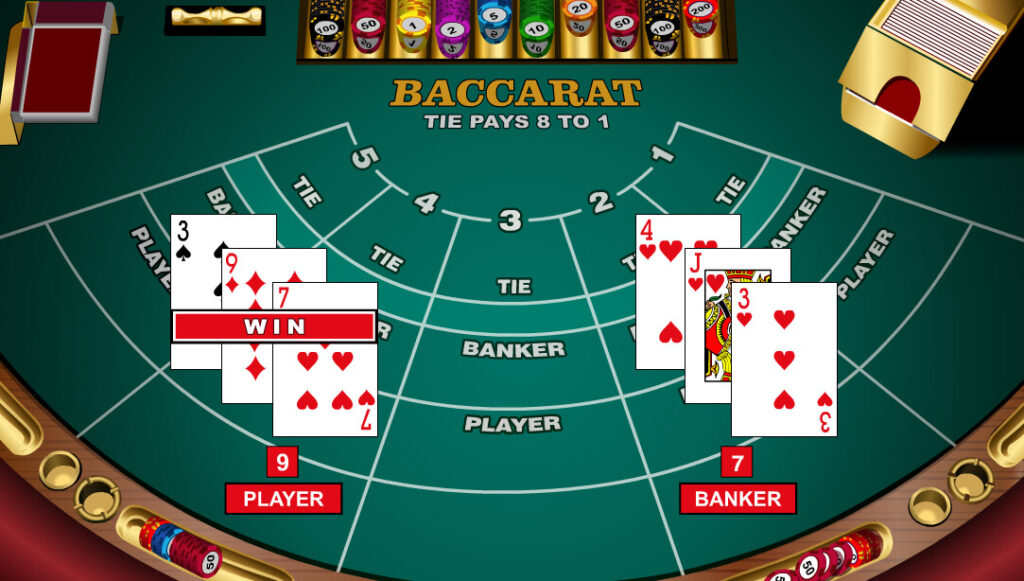
Professional baccarat strategy is less about finding a “perfect” betting pattern and more about understanding where the real risk sits in every decision you make. When you unpack the math, table rules, and your own financial limits, the game stops being a blur of shoe patterns and becomes a series of controlled, measurable choices.
Why Professional Baccarat Strategy Starts With Risk, Not With “Winning Systems”
Skilled players accept that baccarat has a built‑in house edge and that no staking plan can turn it into a positive‑expectation game in the long run. What they can control is how quickly that edge eats through their bankroll, by selecting lower‑edge bets, avoiding volatile side bets, and sizing wagers so a losing run does not immediately end the session. Once you adopt this framing, strategy becomes a question of risk per decision rather than chasing a magical sequence of wins.
Understanding House Edge and Its Practical Impact
House edge is the percentage of each wager that the casino expects to keep over time, and in baccarat it differs sharply between bet types. Banker bets usually carry an edge around 1.06%, Player bets slightly more, while Tie and many side bets can reach double‑digit edges that quietly drain funds despite attractive payouts. The practical consequence is that consistently favouring lower‑edge bets extends session length and makes extreme downswings less frequent, even though it does not guarantee profit.
Evaluating Classic Betting Systems Through Risk Exposure
Many baccarat systems look convincing because they smooth short‑term results, but their true cost shows up during extended losing streaks and under table limits. A risk‑focused player evaluates each system not by past anecdotal results but by asking how quickly bet size grows, how many consecutive losses it can tolerate, and what portion of the bankroll is at risk before a full reset.
Mechanisms of Popular Baccarat Systems
Progressive systems alter bet size after wins or losses, while flat betting keeps stakes constant and shifts focus to bet selection and bankroll discipline. Loss‑chasing structures such as Martingale double the stake after each loss to recover previous deficits with one win, whereas controlled progressions like 1‑3‑2‑4 or 1‑3‑2‑6 increase bets modestly on winning runs and reset quickly when results turn. Understanding these mechanisms makes it clear that any system which accelerates stake growth aggressively raises the probability of hitting table limits or personal ruin before the theoretical recovery occurs.
Martingale and Loss‑Chasing Progressions: Why They Break Under Real Constraints
On paper, Martingale promises that one eventual win will erase all prior losses and add a small profit equal to the first bet. In reality, a modest series of losses forces you to wager a multiple of your initial stake that can exceed both table limits and your bankroll, turning one bad sequence into a catastrophic drawdown. From a risk standpoint, the critical flaw is that exposure grows exponentially while potential profit per cycle remains fixed, creating a lopsided trade‑off where rare but severe failures dominate long‑term outcomes.
Controlled Progressions (1‑3‑2‑4, 1‑3‑2‑6) and Their Hidden Trade‑Offs
Controlled progressions attempt to harness short winning streaks while locking in part of the gains and cutting stake size quickly when the sequence fails. Systems such as 1‑3‑2‑4 and 1‑3‑2‑6 prescribe a fixed order of bet multipliers, which limits drawdowns compared with Martingale because stake growth is linear and capped instead of exponential. The trade‑off is that you still face the same house edge on every hand, so the system mainly reshapes the variance curve rather than changing the underlying expectation.
Before looking at examples, it helps to see how these systems differ in structure and risk profile when applied to baccarat. The table below compares core mechanics and main vulnerabilities, assuming even‑money bets on Banker or Player rather than on high‑edge options.
| System | Bet adjustment rule | Risk profile in practice | Main failure condition |
| Martingale | Double after each loss, reset after a win | Very high; stake grows exponentially | Long losing streak plus table/bankroll limit |
| Paroli | Increase after wins, reset after a loss | Moderate; rides hot streaks, small controlled losses | Extended chop with no streaks |
| 1‑3‑2‑6 / 1‑3‑2‑4 | Fixed sequence on consecutive wins | Lower; capped maximum stake in each cycle | Frequent interruption mid‑sequence |
| Flat betting | Same stake every hand | Stable; variance only from results, not stake changes | House edge slowly eroding bankroll |
These comparisons show that “safer” systems typically cap stake size and reset earlier, which reduces the chance of a ruinous downswing but also softens the upside of rare extended winning streaks. Choosing among them becomes a question of how comfortable you are with volatility, how large your bankroll is relative to your base unit, and whether your priority is session longevity, smoother swings, or occasional high‑variance spikes.
Bankroll Management as the Core Professional Skill
Bankroll management translates abstract probabilities into hard spending limits that you commit to before the first hand is dealt. A typical professional approach is to divide the total bankroll into units of roughly 1–5% each, select a table whose minimum bet fits that unit size, and set predefined thresholds for both maximum drawdown and desired profit at which the session ends. This creates a structural barrier against impulsive decisions, because even a strong emotional urge to chase losses must operate within caps defined when you were still thinking clearly.
Risk Analysis When Playing Through a Betting Platform (UFABET Paragraph)
In many real‑world scenarios, players do not sit at a physical table but instead navigate a digital lobby with dozens of baccarat variants, side bets, and live‑dealer options, and this environment changes how risk is perceived and acted upon. The constant availability of new tables, quick re‑buys, and rapid deal speeds means that your effective number of decisions per hour can double or triple, magnifying the impact of even a small misjudgment in stake size or bet selection. Under these conditions, a disciplined player treats each game offered through UFABET as just another exposure node governed by the same bankroll rules, refusing to increase unit size simply because the interface feels frictionless and remembering that faster hands amplify both good and bad variance without altering the underlying edge.
Psychological Traps: Trend‑Following, Superstition, and Overconfidence
Baccarat’s simple rules make it easy to believe that recent shoe history reveals exploitable trends, even when the probabilities remain essentially unchanged from hand to hand. Studies of baccarat behaviour show that many players follow perceived streaks or patterns, but for standard Banker/Player bets this kind of trend‑following does not inherently increase risk unless it combines with progressive staking or emotional tilt. Superstitions and overconfidence become dangerous when they override preset limits, leading to larger bets on Tie or side options with high house edges purely because a “pattern” feels due.
Online Environments and Structural Risks in casino online
Where games are offered remotely rather than in a physical room, another layer of risk emerges from the ease of continuous play, multiple open tables, and the availability of quick deposits. In these settings, a rational player must think beyond individual hands and view every baccarat session within a broader spending plan that covers other titles, potential side bets, and the cumulative effect of extended screen time on judgment. When engaging with any คาสิโนออนไลน์, the most resilient approach is to decide in advance how much of your overall entertainment budget is allocated to baccarat alone, then stick to slower game speeds, lower‑edge bets, and time‑boxed sessions so that fatigue and impulsivity do not quietly reshape your risk profile.
Summary
Professional‑style baccarat play is built on accepting the house edge and structuring decisions so that no single sequence of hands can inflict disproportionate damage on your bankroll. Analysing each strategy through the lenses of house edge, stake growth, bankroll ratio, and psychological pressure reveals why aggressive loss‑chasing systems collapse under real‑world constraints while controlled progressions and flat betting simply reshape variance without changing the fundamental expectation. In practice, the closest thing to a “professional” baccarat strategy is a disciplined framework that favours low‑edge bets, sets non‑negotiable financial and time limits, and treats every tempting pattern or system as a risk‑management problem rather than a shortcut to guaranteed profit.