
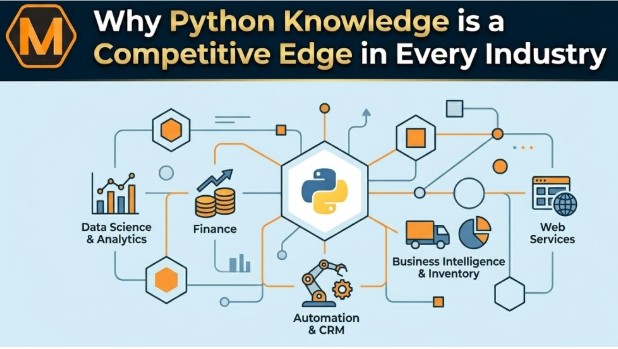
The global job market is undergoing a seismic shift. Gone are the days when “computer literacy” simply meant knowing how to navigate a spreadsheet or draft a professional email. As we move further into 2026, a new universal language has emerged at the forefront of every professional sector: Python. Whether you are studying marketing in Toronto, finance in Mumbai, or healthcare administration in Dubai, the ability to read and write code is no longer a niche skill for software engineers—it is a foundational requirement for career longevity.
For undergraduate students navigating high-pressure degree programs, the challenge is twofold: staying on top of current coursework while simultaneously upskilling for a volatile economy. Many students across the globe are finding that managing these competing priorities requires a strategic approach to their education. To maintain a balanced lifestyle and ensure high-quality submissions, many have integrated professional my assignment help into their routine. This allows them to delegate standard academic tasks while carving out the necessary hours to master technical competencies like data science and automation, which are now the true differentiators in the hiring process.
The Democratization of Data
We are living in the era of “Big Data,” but data is useless without the tools to interpret it. Python has become the industry favorite because of its “English-like” syntax, making it accessible to students who don’t have a background in computer science.
In industries like Digital Marketing, Python is used to scrape consumer sentiment from social media. In Environmental Science, it’s used to model climate change patterns. The competitive edge doesn’t come from just “having” data; it comes from the efficiency with which you can clean, analyze, and visualize that data to make informed business decisions.
Industry Applications of Python
Why Python is the “New Literacy” for Gen Z
For the current generation of students, Python is often referred to as the “Swiss Army Knife” of skills. It isn’t just about building apps; it’s about automation. Imagine a scenario where a junior analyst spends ten hours a week manually copying data from PDFs into Excel. A student with basic Python knowledge can write a script in thirty minutes that completes that same task in seconds.
However, the learning curve for programming can be intimidating, especially when combined with a full course load of theory-based subjects. It is common for students to hit a wall when transitioning from basic logic to complex libraries like Pandas or NumPy. In these moments, seeking specialized Myassignmenthelp python assignment help can be a game-changer. By seeing how experts structure code and debug scripts, students can learn through practical examples, bridge the gap between theory and application, and ensure their technical projects meet industry standards.

The “Work-Smart” Philosophy: Balancing Tech and Academics
The modern undergraduate experience is about more than just a GPA; it is about building a “Competency Stack.” This stack includes your core degree (e.g., Business, Arts, or Science), soft skills (communication and leadership), and a technical layer (Python).
1. Automating the Mundane
Gen Z students are leading the “soft life” movement, which emphasizes efficiency over burnout. Python allows you to automate repetitive tasks, whether it’s organizing research citations or calculating statistical significance in a lab report. By automating the “boring stuff,” you free up mental bandwidth for creative problem-solving.
2. Enhancing Resume Authority
In 2026, recruiters use automated tracking systems (ATS) to scan for specific technical keywords. Having “Python” on a resume—regardless of your major—instantly signals to an employer that you are a self-starter who understands the importance of digital transformation.
3. Global Collaboration
Python is an open-source language with a massive global community. Learning it gives students access to a worldwide network of collaborators. Whether you are in London or Riyadh, the code looks the same, making it the perfect tool for the increasingly remote and international workforce.
Overcoming the “Fear of Code”
Many students avoid Python because they believe they aren’t “math people.” This is a misconception. Modern Python is more about logic and structure than high-level calculus. It is about learning how to break a large problem down into small, manageable steps.
To succeed, students should follow the “30-Minute Rule”: spend thirty minutes every day engaging with code. Whether it’s watching a tutorial, fixing a bug, or reading documentation, consistency beats intensity. If a particular module becomes too overwhelming, don’t hesitate to look for supplementary resources or mentorship to keep your momentum going.
Conclusion: Securing Your Future
As we look toward the latter half of this decade, the divide between “technical” and “non-technical” roles will continue to blur. Undergraduate students who embrace Python today are not just learning a programming language; they are acquiring a mindset of efficiency and analytical rigour.
Frequently Asked Questions (FAQ)
Q1: Do I need a powerful computer to learn Python?
Ans: No. One of the best things about Python is that it is lightweight. You can even run code in your browser using tools like Google Colab, making it accessible on almost any laptop or tablet.
Q2: Is Python still relevant with the rise of AI?
Ans: Absolutely. In fact, Python is the primary language used to build AI. Knowing Python allows you to understand how AI tools work, how to customize them, and how to integrate them into your specific field.
Q3: How long does it take to become “job-ready” in Python?
Ans: For a non-tech major, becoming “proficient” usually takes 3 to 6 months of consistent practice. You don’t need to be an expert; you just need to know enough to solve problems within your specific niche.
Q4: Which industries value Python the most?
Ans: While Finance and Tech are the leaders, we are seeing a massive surge in demand within the Creative Arts (for generative art), Journalism (for data-driven reporting), and Education (for learning analytics).
About The Author
I am Clarence Arney, an academic consultant and content strategist dedicated to helping students navigate the complexities of modern higher education. With a background rooted in digital transformation and educational support, my mission is to bridge the gap between traditional classroom learning and the high-demand technical skills required in today’s global job market.
